

ACI joins COP31 to advance collaboration on airport decarbonisation worldwide
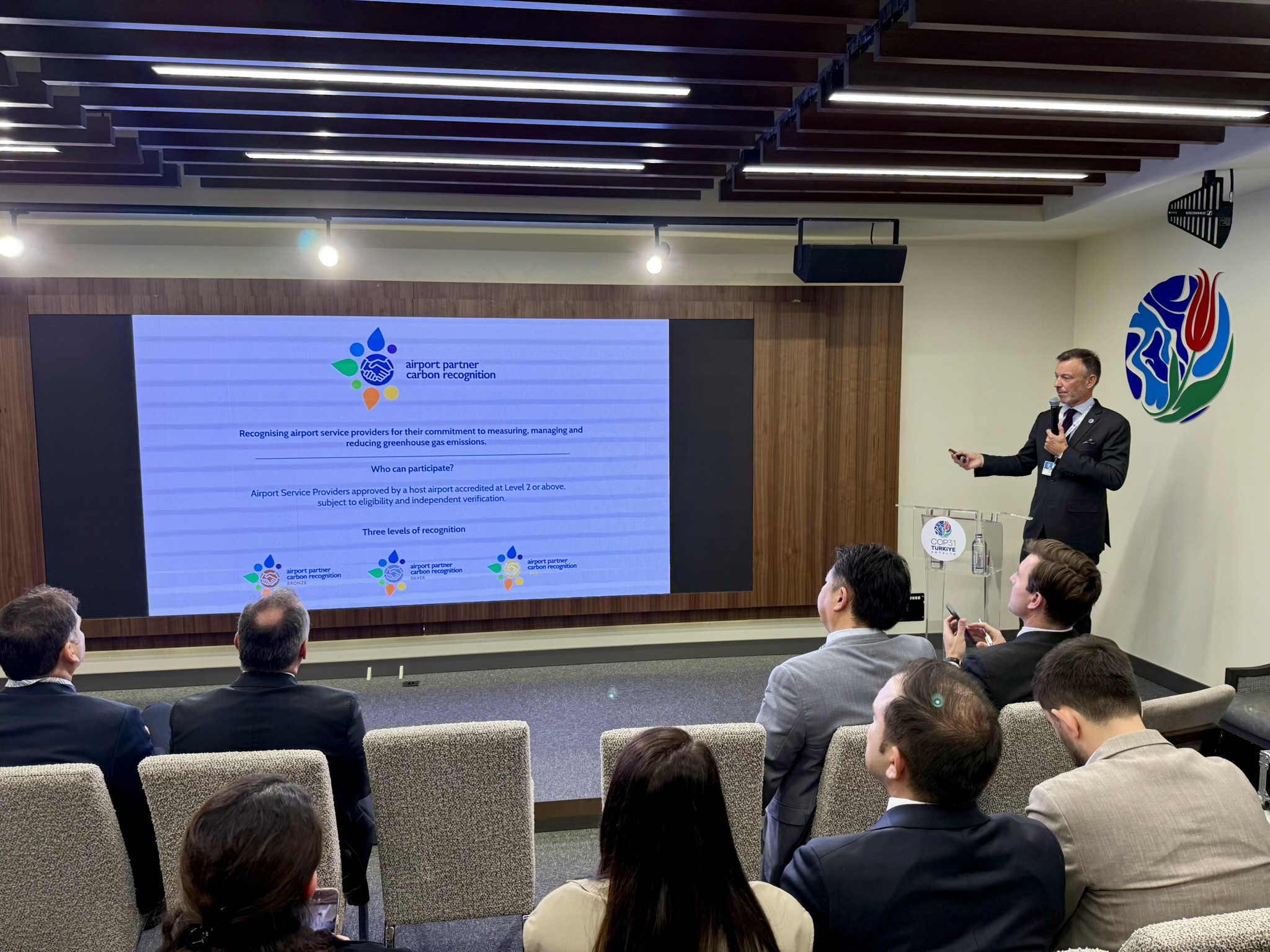
Antalya: At the COP31 in Türkiye, ACI today launched Airport Partner Carbon Recognition, a new voluntary programme under Airport Carbon Accreditation recognising airport service providers for their efforts to measure, manage and reduce carbon emissions. This new Recognition provides a framework for airport partners to join the global airport decarbonisation efforts and contribute to lowering emissions across the airport site.
The launch took place during the COP31 side event Taking Airport Climate Action to the Next Level: From Türkiye to the World, organised by ACI EUROPE in collaboration with Türkiye’s General Directorate of State Airports Authority (DHMI), Antalya Airport, İGA Istanbul Airport and YDA Dalaman Airport.
Held at the Türkiye Pavilion in the COP31 Blue Zone, the event brought together airport and aviation representatives, government and institutional stakeholders to take stock of the progress achieved in airport carbon management and chart the way forward for a Net Zero aviation by 2050. The event was opened by His Excellency, Abdulkadir Uraloğlu, Minister of Transport and Infrastructure of the Republic of Türkiye.
New programme strengthens collaboration across the airport ecosystem
Airport Partner Carbon Recognition complements Airport Carbon Accreditation by extending carbon management across the airport ecosystem and encouraging closer cooperation between airports and their service providers to address carbon. It recognises service providers’ efforts to measure, manage and reduce their CO₂ emissions, covering Scope 1, Scope 2 and selected Scope 3 emissions from their own activities, while supporting airports in addressing their Scope 3 emissions.
The first partners to receive Airport Partner Carbon Recognition were:
- BFA Antalya Havalimanları Yiyecek ve İçecek Hizmetleri A.Ş. and ATU Antalya Mağaza İşletmeciliği A.Ş., for its operations at Antalya Airport;
- Bradford Swissport Limited, for its operations at Heathrow Airport;
- SITA for its operations at Budapest Airport;
- Joramco and Dnata, for its operating at Amman Queen Alia International Airport.
Türkiye’s airports recognised for carbon management
The COP31 side event was an opportunity to formally recognise the recent achievements of Turkish airports within Airport Carbon Accreditation.
- DHMI has 45 airports accredited under the programme, making it the airport operator with the largest number of accredited airports in Europe;
- Antalya Airport was recognised for achieving Level 4+ and İGA Istanbul Airport for Level 4 – at these levels both airports are pursuing decarbonisation pathways fully aligned with the ambition of the Paris Agreement;
- and YDA Dalaman Airport for Level 3+.
Airport Carbon Accreditation continues to expand globally
The Airport Carbon Accreditation Annual Report Year 17, covering the period from May 2025 to May 2026, was also launched during the COP31 event. The report highlights the programme’s continued global growth, with 636 accredited airports in 93 countries across five continents as of May 2026. During the reporting period, 70 airports joined the programme, while 110 airports moved to a higher certification level, reflecting continued performance improvement.
Key findings from the report include:
- More airports pursuing advanced decarbonisation: A total of 121 airports worldwide reached Levels 4 or 4+, an increase of 23.5% compared with the previous reporting year.
- Growth at the highest level: By the end of the reporting period, 30 airports¹ had achieved Level 5, the programme’s highest level – which certifies airports for having achieved a net zero carbon balance on their scope 1 and 2 emissions and committing to achieve Net Zero on their scope 3 emissions. This represents a 43% increase year on year.
- Reduced emissions: Accredited airports collectively reduced their Scope 1 and Scope 2 emissions by 160,024 tonnes of CO₂e, a 2.6% reduction compared with the three year rolling average.
- Lower emissions intensity: Average Scope 1 and Scope 2 emissions fell to 1.47 kg of CO₂e per passenger and 1.29 kg of CO₂e per traffic unit. Compared with the three year rolling average, these represent reductions of 22% and 19%, respectively.
You can download the Annual Report Year 17 here